Karan Casey
Click on one of the above
titles to head straight to the review.
Vertical VERTCD 064; 41
minutes; 2003
The County
Waterford-born singer Karan Casey originally made her name with Solas, her
silkily pure vocals providing a lissom and integral counterpart to the band’s
sometimes frenetic approach to traditional music. Her debut album, 1997’s Songlines
was recorded while she was still a Solas member and it was only with its
successor, The Winds Begin to Sing, released four years’ later, that she
really set forth on her solo career. 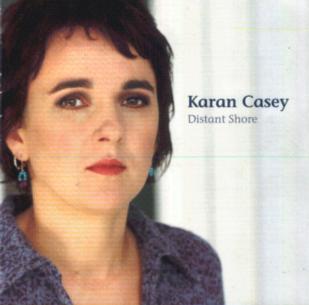
The Winds was produced by Capercaillie’s Donald
Shaw and consisted predominantly of traditional songs, though Karan returned to
her jazz inclinations with Strange Fruit, while also employing the
writing talents of the pairing known as “The Gaelic Hit Factory”, John Spillane
and Louis de Paor.
Distant
Shore functions
on almost identical principles, except this time the traditional ditties take a
back seat in favour of songs from the likes of Billy Bragg (the title track)
and the Irish songwriters Ger Wolfe, Matt McGinn and, again, the “Hit
Factory”. Now therein danger lies since
Karan made a name for herself as a remarkable interpreter of traditional songs,
suiting her somewhat fragile tones to the material. This approach remains
effective on Mary Brookbank’s The Jute Mill Song, but when she sings the
chorus line of Ewan MacColl’s The Ballad of Tim Evans, it’s difficult to
believe that she really means “Go down, you murderer, go down”.
Nevertheless,
solid musicianship from participants such as fiddler Dezi Donnelly,
banjo-player Dirk Powell and concertina-player Niall Vallely, married to
exceptionally sensitive production guarantees Distant Shore’s overall success.
However, in choosing to sing Lord MacDonald’s in Scots Gaelic as a duet
with Karen Matheson there is a lingering sense that Karan Casey might just have
sailed a little too close to the Capercaillie wind.
Vertical VERTCD 070; 50 minutes;
2005
Karan
Casey doesn’t just wear her heart on her sleeve, rather it sits there throbbing
and pounding, suffusing her songs with a vigorous, blood-red sense of purpose.
The woman from County Waterford with the golden voice has so far produced three
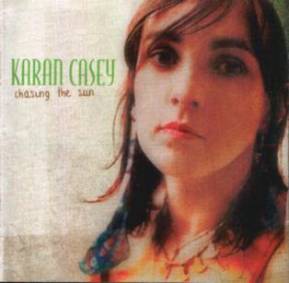
previous impressive solo albums, not counting her work with Solas, but Chasing
the Sun represents a massive leap forward.
 It’s not just the finely-tuned
settings of Karan’s voice against the sparse backdrop of guitar, bouzouki or mandolin,
supported by Ewen Vernall’s utterly understated bass-playing which puts this
album on a higher level than her previous releases. There’s the subtle
injections of Niall Vallely’s concertina for starters and a sensitive use of
overdubbed vocal harmonies.
It’s not just the finely-tuned
settings of Karan’s voice against the sparse backdrop of guitar, bouzouki or mandolin,
supported by Ewen Vernall’s utterly understated bass-playing which puts this
album on a higher level than her previous releases. There’s the subtle
injections of Niall Vallely’s concertina for starters and a sensitive use of
overdubbed vocal harmonies.
Rather,
and key to it all, far more than any of its predecessors, Chasing the Sun
successfully marries a mix of traditional, but ever lyrically-pointed, songs,
such as the epic unaccompanied ballad Jimmy Whelan, with contemporary
material that reflects Karan’s rising status as one of Ireland’s most
politically-charged singers.
Her own
compositions reveal increasing confidence and incisive political awareness, not
least in When Will We All Be Free, which attacks Ireland’s current
policies on immigration. Above all, however, the songs are invigorated by her
gorgeous, sensual, utterly knowing voice.
Ships in the Forest
Crow Valley Music CVCD001; 46 minutes; 2008
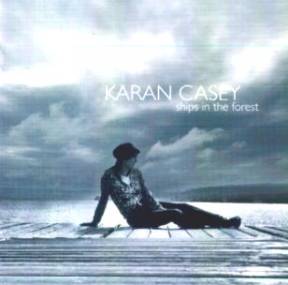
Something has gone terribly awry in the musical world of the Waterford-born singer Karan Casey. In returning to some of the ‘big’ songs of the Irish tradition, the strengths she previously drew from that heritage have been dissipated by a production style which seeks to conjure emotion via sparseness, yet often drifts into vacuity.
 As
ever it’s impossible to deny Karan’s vocal excellence, while the standard of
musicianship is admirable throughout and features the three Vallely brothers on
piano, concertina and uilleann pipes, as well as guitarists Robbie Overson and
Kris Drever, cellist Kate Ellis, bodhránista Martin O’Neill, and producer
Donald Shaw on accordion and keyboards.
As
ever it’s impossible to deny Karan’s vocal excellence, while the standard of
musicianship is admirable throughout and features the three Vallely brothers on
piano, concertina and uilleann pipes, as well as guitarists Robbie Overson and
Kris Drever, cellist Kate Ellis, bodhránista Martin O’Neill, and producer
Donald Shaw on accordion and keyboards.
However, unlike previous albums, Karan’s sweet-as-honeydew voice is offered little scope to explore sentiments outside the gamut of dolour, doom and deprivation. Love is pleasing is one of the great oxymoronic traditional song titles. Poor Johnny loses his legs in Johnny I Hardly Knew Ye, Erin’s Lovely Home is a tongue-in-cheek-titled torrent of the emigrant’s woes and I Once Loved a Lass offers an unrequited suitor the chance of live-burial. Moreover, even the two contemporary songs on the album, Joni Mitchell’s The Fiddle and the Drum and Martin Furey’s Town of Athlone, are both death-focussed, albeit from international and local aspects respectively.
Featuring songs as familiar as Black is the Colour and I Once Loved a Lass suggests that Karan’s inspirational well might be nearing dehydration while listening to this album repeatedly will almost certainly drive you to drink.
All three
reviews by Geoff Wallis were originally written for Songlines magazine –
www.songlines.co.uk.
For more information about Vertical Records visit www.verticalrecords.co.uk.